
Warehouse and Factory Linemarking
Safety zones, walkways, racking bays and traffic flow marking for industrial sites.
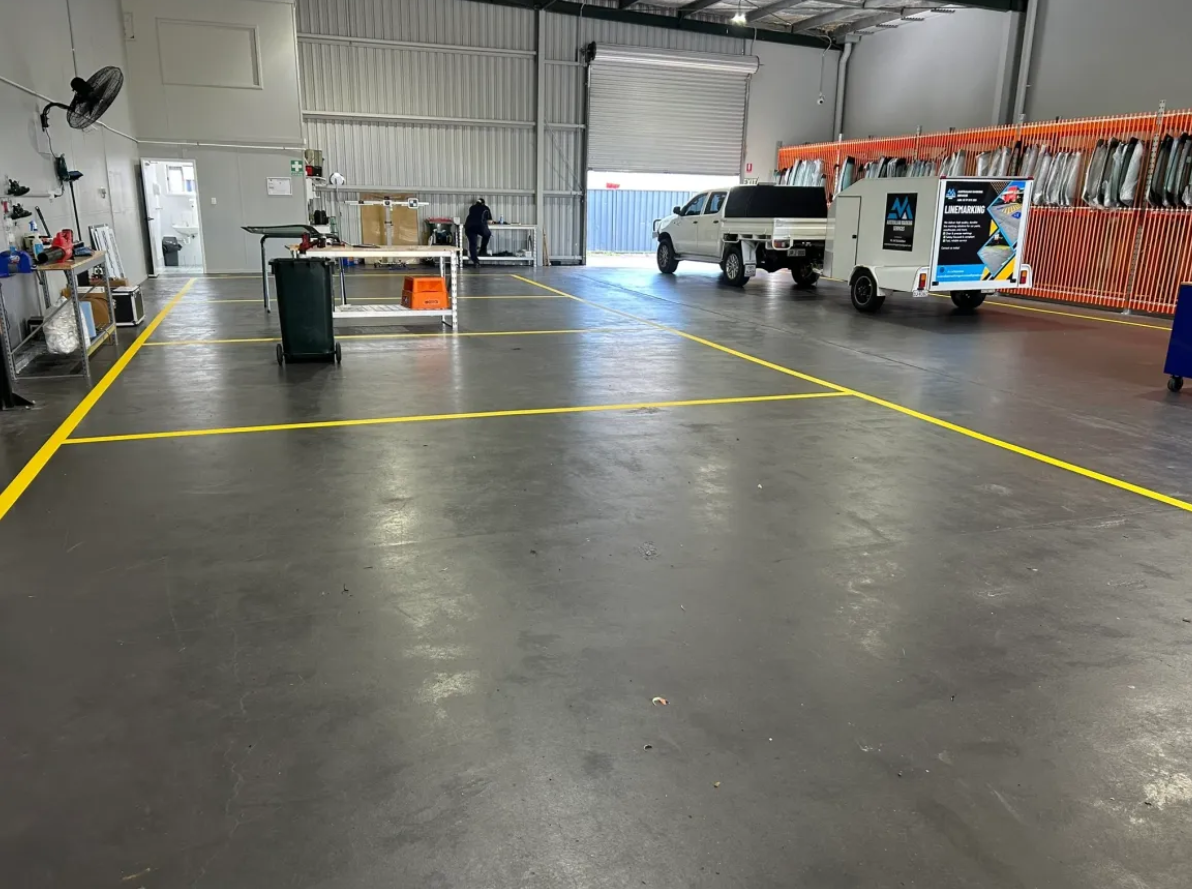
Professional Services
- Clear demarcation of pedestrian walkways and forklift zones
- Safety exclusion zones and hazard markings
- Pallet and racking bay numbering and alignment lines
- Loading dock markings and directional arrows
- Application of heavy-duty, long-lasting industrial coatings
Why Warehouse Safety Line Marking Matters
Warehouse safety line marking plays a critical role in reducing workplace accidents by creating clear visual boundaries between pedestrians, forklifts, and operational areas. Well-designed safety markings help employees navigate the workplace with confidence while reducing the risk of collisions, near misses, and confusion.
Separating Forklifts and Pedestrians
One of the most effective ways to reduce workplace incidents is by clearly separating pedestrians from mobile plant. Dedicated pedestrian walkways provide employees with a safe route through the warehouse while clearly identifying forklift operating zones. Combined with directional arrows, stop bars, and warning markings, professional line marking helps improve awareness for everyone on site.
Improve Traffic Flow & Efficiency
Poor warehouse traffic flow can lead to delays, congestion, and increased safety risks. Professional line marking organises vehicle movements by clearly identifying forklift routes, loading zones, intersections, and turning areas. A well-planned layout supports both operational efficiency and workplace safety.
When Should You Upgrade?
Warehouse layouts often change as businesses expand, introduce new equipment, or modify production processes. Signs your warehouse needs new line marking include faded markings, new forklift traffic routes, increased pedestrian activity, or frequent near misses. Updating your markings improves safety while helping staff understand the correct movement throughout the facility.
Line Marking Services Brisbane: Full Range of Services We Offer
"Line marking" covers a lot more ground than most people expect — a shopping centre car park, a warehouse floor, and a roadway all need completely different standards, materials, and approaches. This page runs through the full range of line marking services we provide across Brisbane, what each one actually involves, and which standards govern it, so you know exactly what to ask for.
Car Park Line Marking
The most requested service we provide — new layouts and re-marks for retail, commercial, medical, and residential car parks across Brisbane, built to AS/NZS 2890.1. This covers bay dimensions, aisle widths, and traffic flow for everything from a small strata car park to a full shopping centre. It also includes accessible bay marking to AS/NZS 2890.6, one of the most commonly non-compliant elements we find during re-marking work. (See our dedicated car park line marking guide for full technical detail on bay dimensions and angle parking.)
Warehouse & Industrial Floor Marking
Warehouse and factory floors need an entirely different framework to a car park — one built around workplace safety rather than parking geometry. Compliance here draws on several overlapping standards rather than one single document:
- AS 1318 — the Australian industrial safety colour code, which defines what each floor marking colour means: yellow for caution and vehicle traffic routes, red for danger and fire equipment zones, green for safety and emergency exit paths, and blue for mandatory action areas
- AS 1319 — governs safety signs and symbol design, working alongside the colour code so a "no pedestrians" or "forklift traffic" symbol means the same thing in every facility a worker walks into
- The Work Health and Safety Act — requires businesses to manage traffic and pedestrian interaction risk, and floor marking is one of the primary controls used to do that
In practice, this means clearly separated pedestrian walkways (typically marked in yellow or white, at least 1000mm wide for single-direction paths), forklift lanes and turning areas, loading dock bay markings and pedestrian exclusion zones, and racking or storage zone boundaries. We provide a colour-coded floor plan with every warehouse job, documenting what each marking means and which standard it references — useful evidence to keep on file for WorkSafe audits.
Line Marking Removal
Before any re-mark, old or non-compliant lines often need to come out first — whether that's faded paint, an outdated layout, or lines left behind after a resurfacing job. We handle removal by grinding, blasting, or chemical stripping depending on the surface and the material originally used, so the new marking goes down on a clean, properly prepared surface rather than over the top of the old one.
Thermoplastic & Epoxy Line Marking
For high-traffic commercial and industrial sites where standard water-based paint won't hold up, thermoplastic and epoxy line marking offer significantly better durability — often lasting several years longer under constant vehicle and foot traffic. Epoxy in particular is common on warehouse floors, since two-pack formulations can include anti-slip aggregate to maintain safe slip resistance even with a painted surface.
Road & Roadway Line Marking
Centrelines, edge lines, directional arrows, and pedestrian crossings on private roads, access ways, and works zones, carried out to AS 1742 — the national Manual of Uniform Traffic Control Devices — and, for anything touching a public road, the Queensland-specific MUTCD published by Transport and Main Roads.
Accessible (Disabled) Parking Bay Marking
While this is included in our car park work, it's worth calling out separately given how often it's the reason a site fails a council or NDIS-related inspection. Compliant accessible bays under AS/NZS 2890.6 need the correct combined bay-plus-shared-zone width, 45-degree yellow hatching in the shared area, a bollard, the International Symbol of Access, and a maximum 1:40 surface gradient.
Fire Lane & Emergency Access Marking
Red and white hatching, "NO PARKING — FIRE LANE" stencilling, and hydrant access marking to keep emergency vehicle access clear at all times — a requirement most commercial sites need to maintain as part of their fire safety compliance.
Sports Court & Recreational Line Marking
Line marking for tennis courts, netball courts, basketball courts, and multi-purpose recreational surfaces, with precise, sport-specific dimensions and colour separation between overlapping court layouts.
Bicycle Lane & End-of-Trip Facility Marking
Green-surfaced cycle lanes, bicycle parking bay marking, and directional signage to AS/NZS 2890.3, increasingly required as part of commercial development approvals across Brisbane.
Where We Provide These Services
All of the above is available across the Brisbane CBD, the Australia TradeCoast precinct, the southern industrial pocket (Acacia Ridge, Archerfield, Rocklea), the South West Industrial Gateway, and every suburb in between — as well as across Logan, Beenleigh, and the wider South East Queensland region.
Get a Quote
Whatever the service, every job is quoted based on your actual site plan, carried out to the relevant Australian Standard, and finished with a written compliance statement.
Get in touch today for a fixed-price quote on any line marking service across Brisbane.
This article is provided as general information and does not replace professional advice. Always confirm current requirements with the relevant Australian Standard, WHS regulator, or local council before undertaking line marking works.
Frequently Asked Questions
Ready to Start Your Project?
Contact Queensland's trusted linemarking professionals today for a free, no-obligation quote.