
Car Park Linemarking
Professional new layouts and remarking for retail, commercial and body corporate car parks.
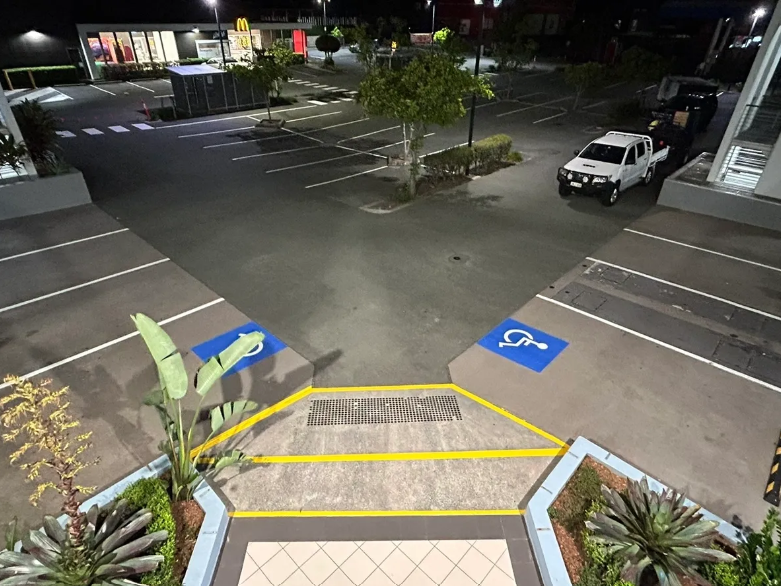
Professional Services
- Custom design and layout planning for optimal space utilization
- Clear, highly visible markings for safety and direction
- Disabled parking bays compliant with Australian Standards
- Pedestrian crossings and safety walkways
- Durable paints and materials designed for heavy traffic
What Is Car Park Line Marking?
Car park line marking involves applying durable painted markings that organise vehicle movement and improve safety for drivers and pedestrians. Common markings include parking bays, disabled spaces, directional arrows, pedestrian crossings, loading zones, stop bars, and keep clear areas. Professionally marked car parks create a better first impression, maximise parking capacity, and improve traffic flow.
Why Should You Refresh Faded Line Marking?
Over time, UV exposure, tyre wear, and weather cause line markings to fade. Faded markings can confuse drivers, reduce visibility, and increase safety risks. Refreshing line marking restores visibility, improves the appearance of your property, and helps maintain compliance with workplace and accessibility requirements. Regular maintenance is more cost-effective than allowing markings to deteriorate completely.
How Often Should Car Parks Be Repainted?
Most commercial car parks benefit from a professional inspection every 12 months. Depending on traffic levels, weather exposure, and the paint system used, line marking may need refreshing every 2 to 5 years. High-traffic areas such as entrances, exits, and pedestrian crossings often require more frequent maintenance than standard parking bays.
What Colour Should Safety Line Marking Be?
Different colours are used to identify different workplace hazards and traffic areas. Yellow is commonly used for pedestrian walkways and general safety markings, while white is typically used for standard parking bays and traffic lanes. Blue identifies accessible parking spaces, and red is often used to highlight fire equipment or emergency access zones.
Car Park Line Marking Brisbane: Compliant Bay Layouts, Costs & What the Standards Actually Require
Getting car park line marking right in Brisbane isn't just about straight lines — it's about hitting exact bay dimensions, aisle widths, and accessible parking requirements set out in the Australian Standards and enforced by Brisbane City Council as a condition of development approval. Get it wrong and you're looking at a failed inspection, a rejected occupancy certificate, or an expensive re-mark. This page breaks down exactly what compliant car park line marking involves, so you know what to expect from any quote.
The Standard That Governs Every Car Park Line Marking Job
Every commercial, retail, and residential car park in Brisbane is governed by AS/NZS 2890.1 — Off-Street Car Parking, most recently updated in its 2021 edition. It sets out precise minimum dimensions for parking bays, aisle widths, and circulation space, based on a system of "user classes" that reflect how a car park is actually used.
Why bay dimensions aren't one-size-fits-all
The standard recognises that a shopping centre car park and an office building's staff parking need different bay sizes, because the frequency of turnover changes how much room drivers need:
- User Class 1A (residential, commuter, long-term/employee parking) — narrower bays are acceptable since drivers are familiar with the space and park infrequently, at a minimum of 2.3m–2.4m wide by 5.4m long
- User Class 3A (shopping centres, medical centres, short-stay visitor parking) — wider bays around 2.6m are required, since infrequent visitors need easier access in and out
- Standard 90-degree bay — the most common layout, typically 2.4m wide by 5.4m long as a baseline
Parking angles and aisle widths
Car parks aren't limited to the standard 90-degree layout. AS/NZS 2890.1 also allows 30, 45, and 60-degree angle parking, which is common where space is tight or a site doesn't lend itself to a 90-degree grid. The trade-off is aisle width: angled parking allows narrower aisles (down to roughly 3.0m–3.5m for one-way 45-degree parking) but the parking angle and the aisle width are directly linked — get one wrong and the whole layout fails compliance. Ninety-degree aisles typically need 5.8m to 6.2m depending on whether traffic flows one-way or two-way. Dead-end aisles also need a minimum 1.0m extension past the final bay to allow vehicles to manoeuvre out.
Accessible Parking Bay Marking
Accessible bays are governed by a separate standard, AS/NZS 2890.6, and are one of the most common sources of non-compliance we see on re-marking jobs. A compliant accessible bay requires:
- A dedicated bay at least 2.4m wide, paired with an adjacent shared zone also at least 2.4m wide — giving a combined footprint of 4.8m
- The shared zone marked with yellow diagonal hatching at 45 degrees to clearly indicate it isn't a parking or stopping area
- A bollard placed within the shared zone to prevent unauthorised vehicles encroaching
- The International Symbol of Access stencilled within the bay
- A maximum surface gradient of 1:40 (2.5%) in any direction, since anything steeper compromises stability for wheelchairs and mobility aids
- Compliant signage featuring the white-on-blue International Symbol of Access
Even a bay that's a few hundred millimetres short of these dimensions can trigger a council compliance notice — it's one of the most common and most expensive mistakes to have to fix after the fact.
What Goes Into a Car Park Line Marking Job
- Site assessment and layout confirmation — checking existing dimensions against AS/NZS 2890.1, or designing a new layout from a site plan
- Surface preparation — sweeping and blowing the surface clean at minimum; grinding or line removal where old, non-compliant, or faded marking needs to come out first
- Layout setting out — measuring and marking bay lines, aisle boundaries, and directional arrows before painting
- Line marking application — water-based paint for standard re-marks, or epoxy/thermoplastic for higher-durability, high-traffic sites
- Stencilling — accessible symbols, directional arrows, speed hump markings, and any custom signage required
- Final inspection and compliance statement — confirming the finished layout meets AS/NZS 2890.1 and 2890.6 as applicable
What Affects the Cost of Car Park Line Marking in Brisbane
- Size of the car park and total number of bays
- Whether it's a re-mark or a new layout — new layouts from a bare slab take longer to set out accurately
- Surface condition — old, heavily faded, or non-compliant lines that need removing before re-marking add time and cost
- Paint type — water-based paint is the standard, cost-effective option; epoxy and thermoplastic cost more upfront but last considerably longer under Brisbane's UV exposure and heavy seasonal rain
- Access and scheduling — CBD basement car parks and high-traffic retail sites often need after-hours or weekend work to avoid disrupting business
Get Compliant Car Park Line Marking in Brisbane
Whether you need a full re-mark, a brand-new car park layout, or an accessible bay compliance upgrade, we work to AS/NZS 2890.1 and AS/NZS 2890.6 on every job and provide a written compliance statement on completion — across the Brisbane CBD, TradeCoast, southern industrial precincts, and every suburb in between.
Get in touch today for a fixed-price quote based on your actual site plan.
This article is provided as general information and does not replace professional or engineering advice. Always confirm current requirements with the relevant Australian Standard and Brisbane City Council before undertaking car park line marking works.
Frequently Asked Questions
Ready to Start Your Project?
Contact Queensland's trusted linemarking professionals today for a free, no-obligation quote.